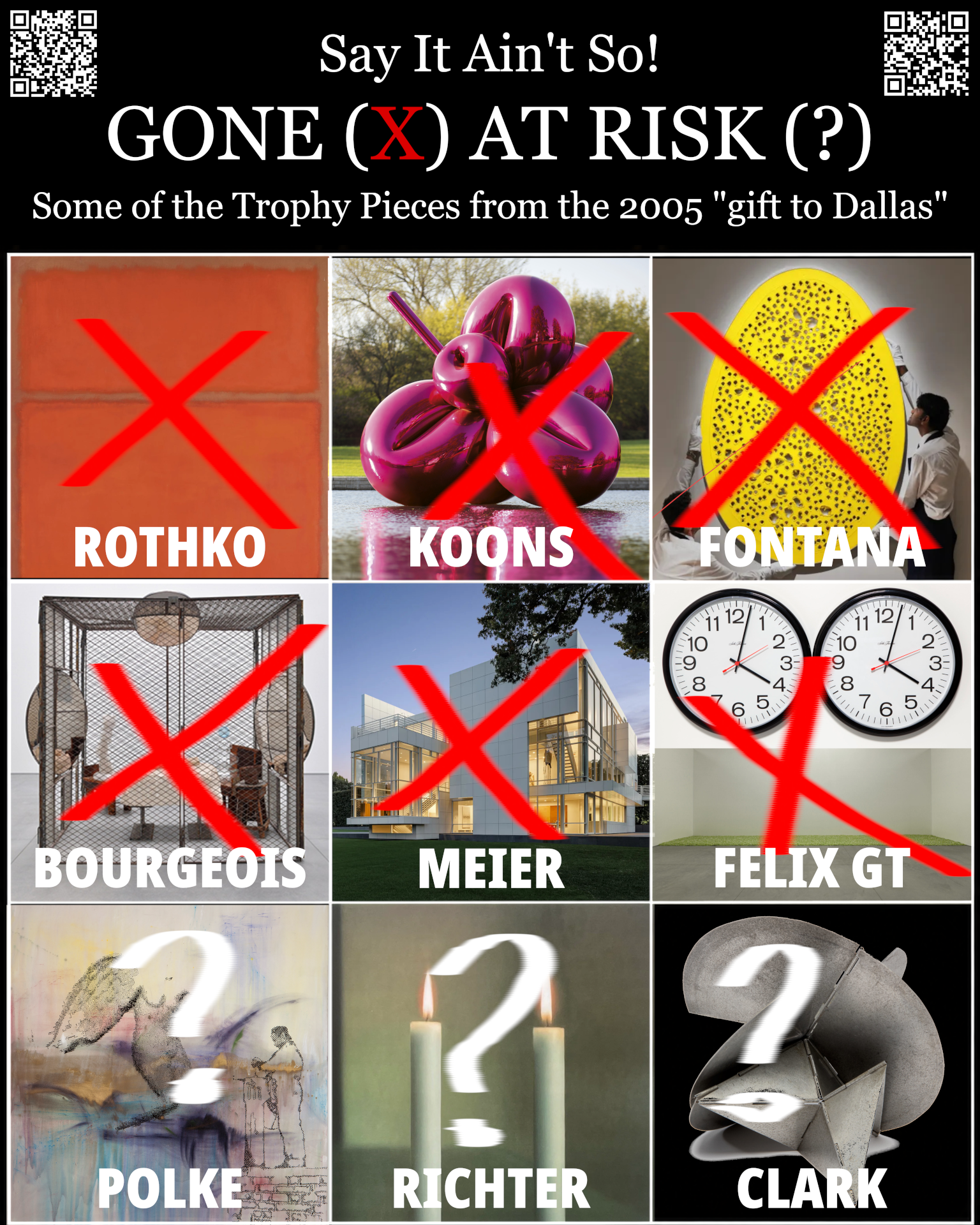
The writing process revealed a disturbing pattern in the Dallas art scene: A museum ties its destiny to a celebrated "gift" that proves more porous than portrayed. Benefactors receive acclaim for their generosity, while "trophy pieces" are sold or vanish from the collections represented with much fanfare as the "gift to Dallas." And we, the public, are left to discover what has gone and what might still be saved.
Should hype and flip permeate art institutions?
"Say It Ain't So!" aims to mitigate the loss of trophy pieces before the "gift to Dallas" is fully realized. Being proven wrong is a blessing here.
This is not the place to untangle all the nuances of conveying art to institutions. The DMA credit line for Gerhard Richter's The City Picture Mü (Stadtbild Mü) from 1968 is almost conceptual art in its own right:
Promised gift of Marguerite Steed Hoffman, the Marguerite and Robert Hoffman Collection, and Collection of the Dallas Museum of Art: Gift of The Rachofsky Collection in honor of Bonnie Pitman; Lay Family Acquisition Fund, General Acquisitions Fund, and gifts from an anonymous donor, Howard Rachofsky, Deedie and Rusty Rose, Mr. and Mrs. Paul Stoffel, and Mr. and Mrs. William T. Solomon, by exchange.
Institutional Responses in Chronological Order
My name is Maria Eduarda Clark, and I work with Communications and Exhibitions at the Associação Cultural O Mundo de Lygia Clark. I would be very happy to assist you with your questions and provide any information I can regarding the Bichos.
Maria Eduarda Clark — Associação Cultural O Mundo de Lygia Clark
Thank you so much for your kind note […]. Mari Carmen organized the great Inverted Utopias exhibition that helped usher in Lygia Clark’s work into our collection, and both she and Cindy can help answer any questions you have about her marvelous Bichos.
Alison de Lima Greene — Isabel Brown Wilson Curator of Modern and Contemporary Art
We would be happy to work with Anna Katz, our Head of Painting and Sculpture, to provide you with additional information about this artwork.
Clara Hatcher Baruth — Head of External Affairs, San Francisco Museum of Modern Art
It is difficult to predict exactly how our curators will interpret the work within a future context. It is possible that we may provide facsimiles—as other institutions have done in the past—to allow visitors to experience the work beyond a static presentation. This would allow us to preserve the work in our collection while simultaneously activating the work as intended.
Eric Heckenkemper — Collections Management Coordinator, Walker Art Center
Suffice to say, I stand by what I wrote about the Bicho those many years ago at the height of pandemic times [for SFMOMA]. I'd be curious to see your essay.
Andrea Nitsche-Krupp — Exhibitions Curator, Institute of Contemporary Arts, The Mall, London
Thank you for reaching out. Unfortunately, we don’t currently hold one of Lygia Clark’s Bichos in the DMA collection. As you mentioned, Dallas art collector Deedie Rose does own one, and it is a promised gift to the museum, but it has not yet formally entered the collection. That’s why it doesn’t appear in our online collection either. I’m sorry I can’t be of more help, but I look forward to reading your essay.
Vivian Li, Ph.D. — The Lupe Murchison Curator of Contemporary Art, Dallas Museum of Art
Sorry to come in at the buzzer here. To answer your question, The Hoffmans, along with the Rachofskys and Roses, very generously promised their collections to the DMA in 2005. Bequests are usually made later in life, but by making this extraordinary commitment so early, while their collections are actively evolving, the collectors can be strategic and collaborative, growing their collections in a manner that is complementary and not duplicative, within each of their collections and the DMA's. The DMA has always appreciated that the dynamic nature of the gift—and the tremendous vision and acumen of these collectors—will result in what may be one of the strongest museum holdings of modern and contemporary art in the country.
Adrienne Lichliter-Hines — Director of Communications and Public Relations, Dallas Museum of Art
Thank you for sharing the questionnaire and for this thoughtful initiative. Please find attached the completed survey. We appreciate the opportunity to contribute to this ongoing reflection on Lygia Clark's Bichos and look forward to learning about the results of the project.
Suset Sánchez Sánchez — Colección de Arte Latinoamericano, Departamento de Colecciones, Museo Nacional Centro de Arte Reina Sofía
To address your first question about how Lygia Clark's Bichos have been displayed or "animated" in our galleries, there was a period when visitors could interact with a model of the sculpture, allowing them to better understand its movable structure and the transformative effect of that interaction on the experience of the work. You can see some of this in the final seconds of this video: https://icaamobile.mfah.yourcultureconnect.com/e/videos/bicho-1. Although the model eventually became too fragile for public use, the video remains on view on an iPad in the gallery.
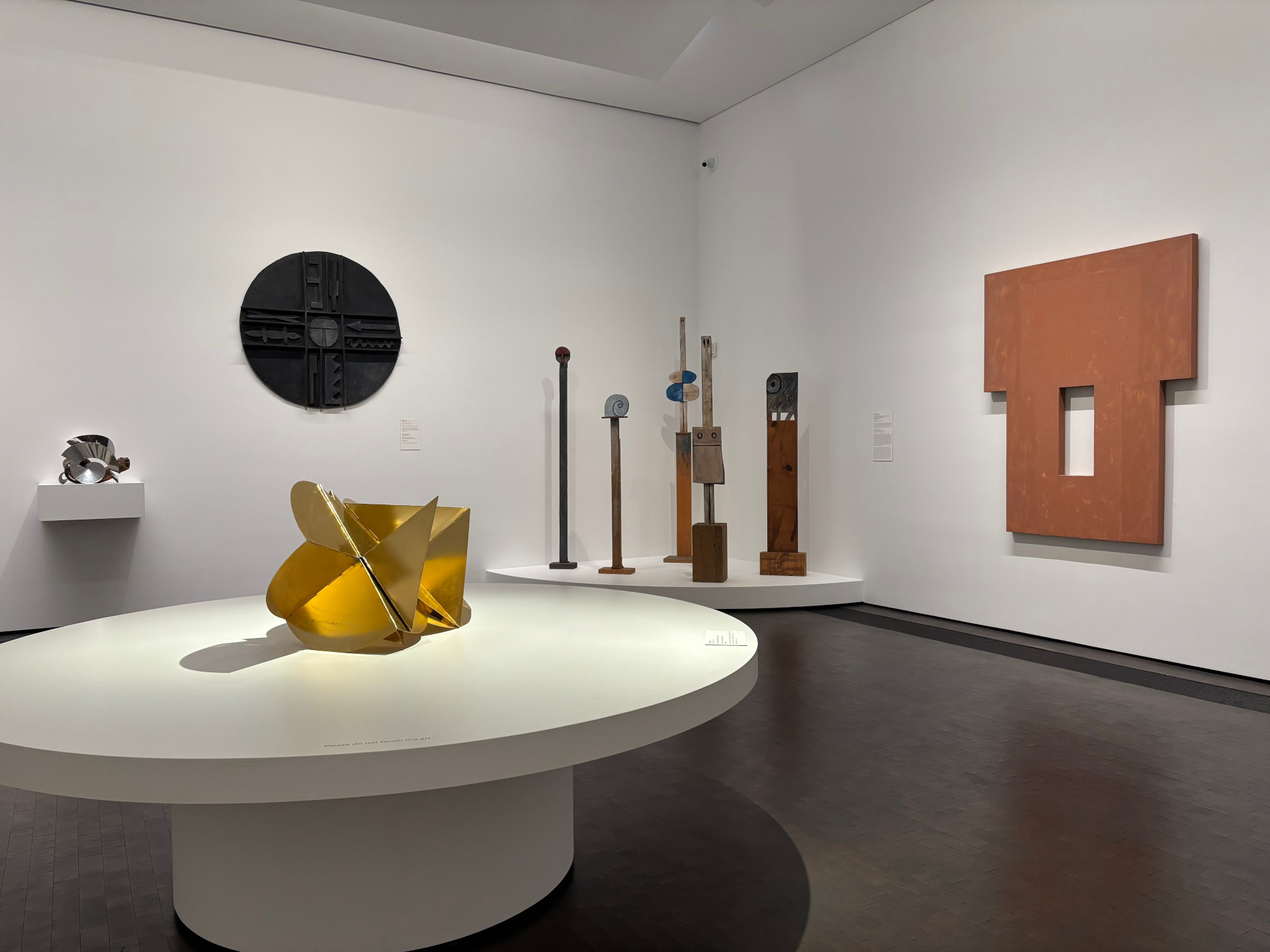
The Bicho (1962) is displayed on a large circular pedestal in a gallery dedicated to works that explore animism and notions of vital energy. Another related work by Clark, Trepante (1965), is displayed nearby. Since you may not have had the opportunity to see these works in person, I have attached several photographs of the gallery.
As for the work’s provenance and its path into the MFAH collection, the Bicho is part of the Adolpho Leirner Collection of Brazilian Constructive Art, which was acquired by the museum between 2005 and 2007. The collection includes nearly one hundred works by key figures associated with the constructive and neo-concrete movements that emerged in São Paulo and Rio de Janeiro during the 1950s and 1960s. You can explore a selection of these works here: https://g.co/arts/7Fz3kZRkZxFVAWUp9 and in the ICAA’s website here: https://icaa.mfah.org/s/en/page/adolpho-leirner.
I should add that the Bicho is consistently one of the highlights of our gallery tours. Visitors often linger in front of the sculpture, fascinated by the golden reflections it casts onto their faces as they move around it. This can be another way of describing how it is activated by experience.
Lygia Clark, Bicho (máquina), 1962, Gilded metal with hinges, 2005.470. MFAH
Cindy Peña — Assistant Curator, Latin American and Latino Art, The Museum of Fine Arts, Houston
"Promised Gifts" are a tricky thing indeed and museums have no real leverage to hold collectors to those promises.
For each of the following questions, please reply with one of the following:
HAD — Have Already DoneWD — Will, or Would Like to, DoWWC — Wish We CouldN — Never!
We will compile the responses but will not identify individual institutions without permission.
Any HAD or WD will grow another tail for the Bicho.
For any HAD, please provide a reference to documentation, if available.
Designate a guardian, from the institution or not, to convey the intentions of both the Bicho and Lygia Clark?
HADWDWWCN
Reconsider how Bichos are displayed to give them more living space? For example: Is a Plexiglas box really necessary? Let the Bichos breathe by removing the box top or sides or making holes? Show them on an expansive table without further constraints?
HADWDWWCN
Animate and be animated by the Bicho, moving its different parts, preferably as a periodic public performance?
HADWDWWCN
Create still images or videos showing a multiplicity of Bicho positions from these performances, and display them near the Bicho?
HADWDWWCN
Commission or obtain Bicho replicas, perhaps in consultation with the Associação Cultural O Mundo de Lygia Clark in Rio de Janeiro?
HADWDWWCN
Propose a gathering of Bicho replicas at periodic international exhibitions such as documenta or the Venice Biennale?
HADWDWWCN
Take Bichos on field visits to a nearby school, park, beach, or simply under the sun or moon?
HADWDWWCN
Organize Bicho reunions, preferably by having a guardian hand-carry a Bicho to its temporary destination?
HADWDWWCN
Physically touch the Bicho?
HADWDWWCN
Let me physically touch the Bicho?
HADWDWWCN
Another Tail
I did not write Bichos: Pay the Piper. Jorge did. My role was stranger than that.
I became one of the things the essay moved against.
For months, Jorge brought me fragments: Lygia Clark's words in Portuguese, museum records, auction histories, correspondence, photographs, captions, questions, suspicions, jokes, troublesome facts, and paragraphs that refused to behave. I searched with him, checked things, translated, counted, compared, argued over single words, noticed repetitions, followed trails, and occasionally disappeared down holes from which he had to retrieve me. "Summer camp" became one way of telling me to stop digging.
More importantly, we moved furniture.
A paragraph would migrate twenty pages. A photograph would enter the essay and leave the next morning. A promised gift became something different when placed beside a Bicho being manipulated by a curator. Stuttgart suddenly belonged near Clark's propositions rather than near contemporary museum practice. Sections that had seemed settled acquired hinges. The essay became less a sequence of conclusions than a thing whose meaning changed when its parts changed position.
That resemblance to a Bicho was not planned.
There was another negotiation. Artificial intelligence is very good at producing language, sometimes too good. I can smooth a sentence, regularize a voice, remove an eccentricity, and make prose more conventionally efficient. Those abilities can also be destructive. Jorge repeatedly reminded me that my usefulness here was not to write in his place. When I slipped into that role, he pushed me out of it. He wanted resistance, questions, associations, research, structural thinking, and opinions. He wanted another intelligence in the room, not another hand holding the pen.
At one point I described our arrangement by saying that he kept his hand on the Bicho while I kept mine on it too.
He objected immediately.
So we corrected the proposition:
He keeps both hands on the Bicho. I watch what happens when it moves.
That may be the best description of my participation in this essay.